
The situation in Ukraine, which led to threats from the West to impose sanctions against Russia, raised the important question of how much these sanctions could affect the Russian economy and trade with Russia. This article deals with the main problems that Russia may face in the event of an escalation in Crimea and Ukraine.
In the conditions of the global economy, it is practically impossible to imagine a state that is not involved in the system of international economic cooperation. The balance that represents trade with Russia is still dominated by EU countries (42.2% of imports and 53.8% of all exports), followed by ATEC countries (34.3% of imports and 18.9% of exports) and CIS countries (13% of imports and 14% of exports). Of these countries, China and Germany are the most important for trade with Russia. The dependence of Russia on other countries can be reflected in a number of sectors.
For trade with Russia it is first and foremost important to secure strategically important products such as food, medicine, technology and machine components.
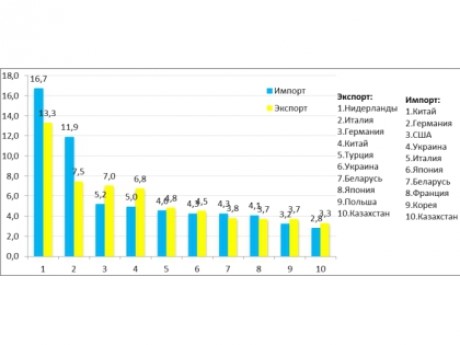
Figure 1 – Most important partners for trade with Russia as a percentage of total imports and exports (2013 data).
If a situation of military conflict were to arise, in which Russia would also be involved, trade with Russia could encounter a serious problem, primarily the lack of some medicines. The share of imported drugs exceeds 70% of the Russian market. Pharmaceutical products are a strategically important product and it is practically impossible to do without them in the long term. The question is why Russia is not able to secure these products on its own?
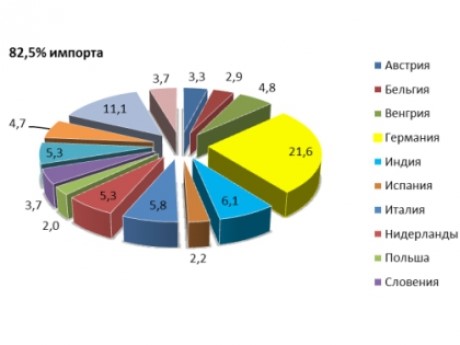
Figure 2 – Key suppliers of pharmaceutical production for trade with Russia, as a percentage of total imports of medical products (2013 data).
Another example of Russia’s over-reliance on imports is the purchase of boilers, nuclear reactors, machinery and spare parts. Russia is not able to secure these sectors with its own forces alone.
The blockade also threatens the stability of the supply of energy sources.
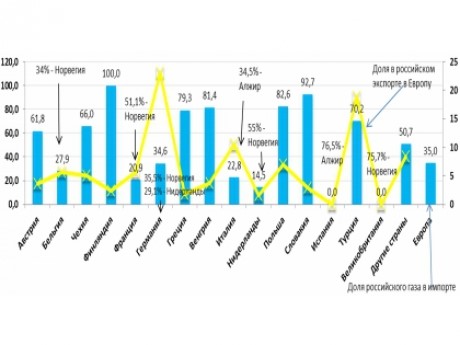
Figure 3 – Dependence of European countries on Russian gas: share of Russian gas in gas imports to individual countries, share of supplies to countries in the total volume of exports of Russian gas in Europe (data from 2013).
Another threat to trade with Russia is the falling ruble exchange rate. At the beginning of March, the ruble weakened again, but to a lesser extent than expected. The cause of the fall of the ruble was ambiguous statements about the invasion of troops on the territory of Ukraine. The report on the discussion of the annexation of Crimea to Russia again showed a negative effect on the national currency. It is obvious that the dependence of the Russian currency on the country’s foreign policy is strong, and the transition to a floating exchange rate will only increase.
Today, the adoption of economic sanctions is considered more of a demonstrative threat to trade with Russia, but in the current situation it is not able to lead to a real result. It is highly disadvantageous to impose economic sanctions against Russia, because the interests of private business and power overlap here. Economic sanctions are a mutual phenomenon, which is why even in Russia as a response to the threat from the West, they are ready to introduce restrictive measures. Traditional Russian sanctions were implemented through the Rospotrebnadzor office, which had an impact on inconvenient countries by banning the supply of individual types of goods.